Kia Engine Diagnostic Service in Homestead, FL

Trusted Engine Diagnostics for Drivers Around Homestead
A glowing check engine light, a sudden shudder at a stop or a dip in power on the highway all say something inside the engine management system has changed. The diagnostic team at South Dade Kia Homestead in Homestead, FL works to find out exactly what. We diagnose engine problems on all makes and models, from older sedans to the newest crossovers. A stored code is where our work begins rather than where it ends, because the real answer comes from testing the part, wire or condition the code points toward. Before we recommend a repair, you hear in plain words what failed and why.
From Daily Wear to Long-Term Care: Your Engine Management System Explained
A modern engine is run by a computer, usually called the engine control module, that adjusts fuel delivery, spark timing and airflow many times a second. It relies on a network of sensors measuring the air entering the engine, oxygen in the exhaust, coolant temperature, crankshaft position and throttle angle. When a reading strays outside the limits the module expects, it stores a trouble code and may switch on the check engine light.
The module also runs self-tests, called monitors, that watch systems such as the catalytic converter and the oxygen sensors while you drive. Some faults set a code after a single failed test, while others must repeat over several drive cycles before the light appears. That is why a light can show up days after the problem actually started.
- A trouble code names the circuit or condition that failed a test, but it does not name the part that caused that failure.
- Freeze frame data captures engine speed, temperature, load and other readings at the moment a code set, giving technicians a snapshot of the conditions.
- Fuel trim values show how much the computer is adding or subtracting to compensate, which can expose an air leak or a lazy sensor before a code appears.
- Pending codes record a fault seen once, while confirmed codes mean it repeated, and that difference helps separate a passing glitch from a real failure.
- Misfire counters track cylinders individually, letting a technician see whether one cylinder or the whole engine is struggling to fire cleanly.
Sensors talk to the module through wiring harnesses and connectors, and the signals they send are small enough that a little resistance can distort them. A connector with a green film of corrosion on its pins can make a healthy sensor look faulty. Good diagnosis therefore checks the signal at the module as well as at the sensor itself.
A common belief is that a handheld code reader tells you exactly what to replace. The reader only reports which test failed, and a code for a lean condition could come from a cracked intake hose, a leaking gasket or a dirty airflow sensor. Treat the code as an opening clue and let testing identify the part.
Sounds, Smells and Sensations Linked to the Engine Management System
Humidity is a constant factor in South Florida diagnostics. Moisture works its way into connectors, ground points and harness junctions, and over time it builds corrosion that causes intermittent faults, the kind that come and go with the weather. A car that runs perfectly on a dry morning and stumbles after an afternoon downpour often has exactly this kind of problem.
Driving through standing water after heavy rain creates a different set of risks. Water splashed into the engine bay can soak sensors and connectors, and water drawn into the air intake can damage the engine itself. If the engine stalled while you were in deep water, do not try to restart it, and have it inspected before driving again.
- A flashing check engine light usually signals a severe misfire that can overheat the catalytic converter, so ease off and have the car checked promptly.
- An engine that suddenly feels sluggish and will not rev past a certain point may be in a protective limp mode set by the computer.
- Several warning lights appearing together after rain or a car wash often point to moisture in a shared connector or ground, a single fault behind several symptoms.
- A light that goes out by itself has not necessarily repaired anything, because the stored code and its freeze frame often stay in memory for a technician to read.
- A strong sulfur odor from the tailpipe that accompanies a code can point toward a catalytic converter that is struggling to keep up.
Intermittent faults are the hardest to pin down, because the car may behave perfectly once it reaches the shop. Technicians use stored data, wiggle tests on harnesses and sometimes a data logger on a road test to catch the fault while it happens. Clearing codes without finding the cause only erases that evidence.
Getting a light checked early keeps a small fault from growing into a larger one. A misfire left alone can ruin a catalytic converter, and a sensor sending bad data can make the engine run rich and foul its spark plugs. A scan and inspection now is usually far simpler than the repair that follows a season of ignoring it.
From Inspection to Repair at South Dade Kia Homestead
Our diagnostic services cover warning lights, drivability concerns and electrical faults on all makes and models.
Check Engine Code Analysis
We connect a professional scan tool to read stored, pending and history codes along with the freeze frame data behind them. The technician compares those codes against technical service bulletins and known patterns for your vehicle. Live sensor data is reviewed with the engine running so the readings can be judged in real time. You receive a plain explanation of what the codes mean and which tests come next.
Wiring and Connector Testing
Many engine faults trace back to a damaged wire, a loose ground or a corroded connector while the component itself is fine. Technicians trace the circuit with a multimeter and wiring diagrams, checking for resistance, shorts and broken strands. Connectors are opened and inspected for green corrosion or pushed-back pins, a common result of humidity. Repairs are sealed against moisture so the same fault does not return with the next rainy season.
Drivability and Water Exposure Inspection
When a car runs rough, stalls or feels down on power, we road test it and watch live data to see when and where the problem happens. Vehicles that have driven through deep standing water get a check of the air intake path and low-mounted sensors for water entry. Engine oil and other fluids are checked for milky contamination as well. The goal is to catch hidden damage before it turns into a major failure.
Getting It Right on the First Visit
Our diagnostic process follows the evidence step by step. The technician starts with a conversation about the symptoms, because the details you share narrow the search before a tool is ever connected.
Picture a driver who sees the check engine light come on after a heavy storm and is told the code calls for a new oxygen sensor. Testing at the module could instead show the sensor working perfectly while its connector, mounted low under the car, has filled with water and corroded. Cleaning and sealing that connector solves the problem, and a new sensor would have changed nothing.
- Codes and freeze frame data are recorded before anything is cleared, so the original evidence is never lost.
- A visual inspection checks vacuum hoses, harness routing and connectors for cracks, chafing or corrosion before deeper testing begins.
- Pinpoint tests measure the actual signal from the suspect sensor or circuit, confirming the cause before anyone trusts the code alone.
- When a fault appears only under certain conditions, the technician recreates those conditions on a road test whenever it is safe to do so.
After the repair, codes are cleared and the technician drives the car through the conditions needed to run the relevant self-tests. Monitors that complete without a failure confirm the fix, and live data is checked once more to make sure readings are back where they belong. If a monitor cannot finish on that drive, your advisor will explain what kind of driving completes it.
Diagnosis at South Dade Kia Homestead is open to all makes and models, and a domestic pickup or a European sedan gets the same methodical testing as a Kia. A straightforward code read and inspection can often be finished the same day when the schedule and parts allow, though an intermittent fault may need more time behind the wheel to reproduce.
Engine Service From South Dade Kia Homestead Near Homestead
Kia owners at South Dade Kia Homestead benefit from factory-trained technicians who know the engine controls used in the Sportage and Sorento as well as the Telluride, Carnival, Seltos and Soul. They use Kia's dealer diagnostic software, which can reach module data and run tests that many generic scan tools cannot. Specifications are confirmed by VIN, so each test is judged against the exact build of your vehicle.
We tell you up front what the first stage of diagnosis covers, and your advisor checks in before any additional testing time is added. If the answer is simple, you hear it quickly, and if the fault needs more chasing, you get an honest picture of how long that may take.
- Software updates released by Kia for engine control modules can be checked and applied when they address your concern.
- Your advisor can tell you whether a known Kia service bulletin matches the symptoms you described.
- Findings are written in plain language, with urgent items separated from those that can simply be watched.
Find South Dade Kia Homestead in Homestead, FL
Communities We Serve Near Homestead
Afternoon downpours and heavy humidity keep electrical faults busy in Homestead, and drivers from across the area come to us once a dash light keeps returning after every quick fix. Commuters along Campbell Drive and people driving in and out of Homestead Air Reserve Base depend on vehicles that start and run day after day, so they want a real answer instead of a cleared code.
- Leisure City, FL
- Princeton, FL
- Cutler Bay, FL
- Kendall, FL
- Pinecrest, FL
- Richmond Heights, FL
- Homestead Base, FL
- Key Largo, FL
When a warning light is glowing, the stored codes are a starting point and our technicians take it from there.
What Drivers Want to Know About Their Engine Management System
Drivers often ask our advisors these questions about warning lights and engine diagnosis.
Q: Why did my check engine light come on right after I filled up?
Q: Is it safe to drive with a steady check engine light?
Q: Can a weak battery set off engine warning lights?
Q: Can aftermarket accessories cause a check engine light?
Q: Why did the light come back after another shop replaced a part?
Give our service desk a ring, describe what the dash showed and how the engine felt, and an advisor will outline the first round of testing.
Every detail you remember helps.
Get Your Engine Management System on the Schedule
Warning lights rarely fix themselves, and a fault that keeps running can damage expensive components downstream. A misfire, a lean condition or a corroded connector all cost less to address before they spread. Having the car scanned soon keeps the repair as small as possible.
Before any repair begins, your advisor shares what testing found and what the fix involves, and nothing moves ahead without your go-ahead. You decide which items happen now and which can wait.
Request an appointment online, phone South Dade Kia Homestead, or simply come by with the light still on so the technician can read it fresh. A clear diagnosis starts with that first scan.
Service Specials


Firestone
Up to $70 Prepaid Mastercard
Specific Model Lines

Bridgestone
$80 Prepaid Mastercard
Specific Model Lines

Yokohama
$80 Prepaid Mastercard
Specific Model Lines

Goodyear
$100 Prepaid Mastercard
Specific Model Lines

Cooper Tires
$80 Prepaid Mastercard
Specific Model Lines

Michelin
$80 Visa Reward Card
Specific Model Lines

BFGoodrich
$80 Visa Reward Card
Specific Model Lines

Full Synthetic Oil and Filter
Complimentary: Multi Point Inspection, Battery Check, Brake Inspection, Tire and Alignment Check

Pick Up & Delivery for Service
Add a Rental for $30 more! Deposit on Vehicle Additional

R&R Brake Pads & Turn Rotors
Special Promotional Price Starting at $369.00
Most Vehicles
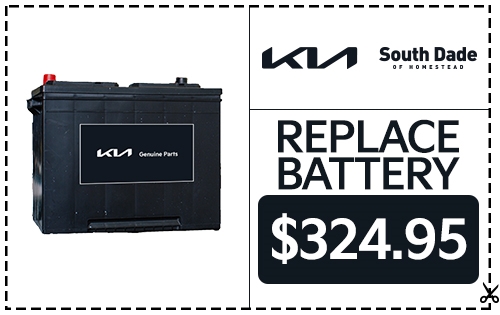
Replace Battery
Special Promotional Price Starting at $369.00
Most Vehicles

4 Wheel Alignment
Computerized four wheel alignment includes, adjusting the camber, caster, and toe angles of the suspension to factory specifications, if applicable.

Better Care Service
Included: Synthetic Oil & Filter Change, Tire Rotation, Air & Cabin Filter Replacement, Front Wiper Blades Replacement



Tire & Wheel Package
Includes: Wheel Alignment, Wheel Rotation & Balance, Multi Point Inspection, Complimentary Battery Check, Complimentary Brake Inspection, Complimentary Tire
Read More